Showing posts with label Barack Obama. Show all posts

Thursday, October 03, 2013

Government Shutdown: Political Apathy Leads to Hyper-Partisanship, Leads to Desperate Gambits

How is it that about 80 Republicans can shut a government down, send 800,000 government employees home without pay, and effectively hold an entire country's legislature hostage?

It seems ludicrous. There are 435 Representatives and 100 Senators. How can just 80 befuddle their 450 colleagues?

Those 80 are elected from hyper-partisan districts that absolutely despise Obamacare and are willing to do just about anything within the law to defeat it. Those 80 are vital to Republican control of the House. And the Democrats don't want to negotiate with those 80. Which is an important fact that's being passed over.

There was very little effort among the Democrats to reach an understanding with the Tea Party wing of the Congressional Republicans. And while this shutdown has been caused by that conservative faction, the Democrats let it happen. Which is a smart political move. As Napoleon is believed to have said "Never interfere with the enemy when he is in the process of destroying himself." And that's what the Tea Party and the Republicans are doing.

At the same time, this extreme faction of the Republican party was duly elected by actual voters. For years, there has been a swelling movement of people who believe in strict conservative ideas. The Left has tried to dismiss these people as racist and ignorant. They've been dubbed "tea-baggers" (even a Senate Democrat used that crude term a few days ago). But they are voters, and they have expressed their "extreme" conservative views with their votes and elected many of the 80 Republicans who have shut the government down.

And that's the problem these days. Only people with strong, strict, extreme beliefs actively participate in politics these days. Only people with firm convictions play any role in the political process. When only uncompromising people engage in politics, why are we shocked when there is no compromise?

Even those of us that regularly vote don't follow politics closely. We know more about our fantasy football teams than we do about our Representatives and Senators. We read tabloid websites about celebrity hook-ups. We squabble with friends and strangers about college football rankings, and Manning vs. Brady, and PEDs in baseball.

And that's fine, except when half the country doesn't vote, and most of the people that do vote only take a passing interest in politics. Then we create a vacuum, a breeding ground for hyper-partisanship. Because only the hyper-partisans in our country take an active role in the political process.

Things are so divided in Congress because only the supporters of the extreme wing of each party invest themselves in politics. Most of us don't care. We gripe about our leaders and representatives, then continue to elect them and pay their salaries. Only for a few months every 4 years do we pay attention to what's happening, and who runs our country.

Even though I'm a conservative, I do hope this latest Tea Party gambit fails. This kind of brinkmanship (please, political pundits, stop saying "game of chicken" when there's a perfectly good word to use) is a shallow, unevolved, and unproductive way to accomplish objectives. It's also not in the spirit of a representative democracy. Representatives from a handful of districts shouldn't wield more power than those from the rest of the country. And any political mechanism or ploy that allows them to do so is undemocratic.

I don't like Obamacare. But I want to see it repealed the same way it was passed, fair and square (although it wasn't called a tax when it was moving through Congress, then the Supreme Court upheld it because it was a tax, but that's just typical misleading political labeling). It's law right now. Congress approved it, the President signed it, the Supreme Court upheld it. Conservatives, especially those who claim to love the Constitution, should swallow their pride and live with it, hoping to convince people to repeal it through traditional, Constitutional means.

To Tea Party people, what would John Adams or George Washington say about this government shutdown? What would Jefferson, the ultimate anti-big-government guy, have to say about this strategy?

I don't think many Founding Fathers in tri-corner hats would approve.

Wednesday, September 04, 2013

No Defined Objectives or Path to Victory in Syria

I honestly don't know what to think about getting militarily involved in Syria's Civil War. I don't know because I don't know what exactly that involvement hopes to achieve. Before going to war, a country should define its ultimate objectives. Then the country should define a path to victory that achieves those objectives. Finally, the country must ask itself if those objectives are worth the use of force and if the defined victory can feasibly be achieved.

In the American Revolution, for example, the British objective was simple: restore British order and control in the American colonies. However, their path to achieving that victory was much more complex and eventually unfeasible. They had to eliminate or scatter all enemy armies, conquer and control cities and vast areas of countryside, and do so without alienating the local population (which they did by allying themselves with Native Americans).

All the Americans had to do was survive as a fighting force.

The Redcoats were rarely beaten on the battlefield. Even after the surrender at Yorktown they still had significant forces available to them. The British weren't driven to the sea, they were recalled by a Parliament that finally tired of the war.

A similar thing happened in Vietnam. All the North Vietnamese Army and Viet Cong had to do was survive, while America needed to conquer land, as well as hearts and minds. That's pretty much impossible to do.

Then we get to the First Iraq War. Easily defined victory there: Eliminate and eject Iraqi forces from Kuwait, seriously weaken their ability to wage any future offensive wars. A definition of victory that could be achieved, and was.

The Second Iraq War and Afghanistan, not so much. The objectives were complex and the paths to victory was unclear. Remove current governments, install democracy, keep the peace in cities and countryside, oversee the conversion from militaristic dictators to peaceful democracies, rebuild infrastructure, rebuild economies, fight local and foreign terrorism, support national and local government institutions, fight corruption in national and local government institutions, secure a massive borders and isolated hinterlands. That's something you can't draw a battle plan for.

So what's the goal in Syria? Do we want to destroy all the chemical weapons? I'd support that objective, but then ask the tough question "how?" How could we do that without committing ground troops who would search buildings and underground storage dumps? Removing all chemical weapons is a fine goal, but difficult/impossible to achieve.

How about removing Assad? That can be done with an assassination or bombing whatever building he's in. But I'm not sure I like this as an objective. Assad's replacement will likely be just as bad, whether he's from Assad's camp or from the opposition. And there's something especially unsavory about people who assume power in vacuums. At least when power is won, even with brutality, the one holding the power has earned it in some way. People who assume power in vacuums tend to more grotesquely abuse that power.

One objective that might be feasible is to cripple Assad's ability to deliver chemical weapons. This means destroying missile and rocket launchers. I don't think we'd ever be able to eliminate all chemical weapons without a ground campaign (in other words, without getting us intimately involved in their war), and the air campaign would last an indefinite amount of time (perhaps as long as the war). But we can make it difficult and dangerous for Assad's chemical warfare troops and equipment. We can call it Operation Referee.

At the same time, intervention might not be a long term positive for Syria or its people. We intervened in Afghanistan in the 1980s when the Soviets were trying to conquer that country. It was a moral war to get involved in, there was a path to victory, and we prevented the Soviet Union from taking over. Years later some of the men we trained, like Osama bin Laden, turned against us. That was bad for the US and was bad for many people in Afghanistan.

Sometimes even good interventions have bad results.

So what's the objective in Syria? We're not going to try to end the Syrian Civil War. We don't want to support one side or another. So what is it that we want to achieve? NO OTHER QUESTION CAN BE ANSWERED UNTIL THIS ONE IS. We cannot decide whether to engage in Syria until we know what we'll try to do there and how we'll try to get it done.

The Left criticized G.W. Bush for not having an Exit Strategy in Iraq. Rightfully so. Before the exit, though, you need a path to victory. How do you get from the start of involvement towards your goal? We don't know what victory is yet, let alone the route to get there.

I blame Obama for the current cloudy and confused situation we are in with this mess. His stupid Red Line decree put himself against the wall, not Assad. Although now Obama denies setting a Red Line. Even though he did...


One perk to being a Liberal is that you can say what you want, then deny what your words meant because people who aren't as smart as you (which is everyone who criticizes you) misinterpreted what you were trying to convey.

Also, if he doesn't want to activate the military without Congressional assent, perhaps he shouldn't have set a Red Line without first conferring with Congress.

What he did was bluff. And Assad raised. And the proper thing to do after a failed bluff is fold. It'is braver to retreat and be embarrassed than it is to attack and be destroyed with pride. It's also the smart thing to do and it's the only thing to do. Live to fight another day. That's a figure of speech for Obama, but also a reality for the American servicemen who would be risking their lives in and above Syria, trying to attain a victory that can't be attained, and attempting to reach an objective that either isn't worth achieving or cannot be achieved.

Friday, May 10, 2013

Since When Did Criticizing Become Politicizing?

The questions would stop if the answers started.

On September 11, 2012, four Americans were killed in Benghazi, Libya, including an Ambassador. That's a fact. There were several requests for added security before the attack, and those requests were denied. Another fact. As the consulate was being attacked, there were pleas for help. Nearby special forces were ordered to not help. As the country reacted to these deaths, US Ambassador to the UN Susan Rice went on the Sunday talk shows and repeatedly insisted that the attacks were a spontaneous and unplanned part of a demonstration protesting an anti-Muslim YouTube video that had sparked rage in the Islamic community. This was not a fact. This was not supported or even suggested by any evidence, and it eventually became clear that the deaths of 4 Americans were the result of a planned attack by terrorists.

However, if you criticize the actions of the State Department that didn't help their Ambassador, you are politicizing. If you question the role of the Secretary of State in all of this, you are politicizing. If you ask what Obama was doing as these attacks were taking place, you are politicizing. If you ask why Rice, an appointed voice of the Obama Administration, was talking about YouTube videos, you are politicizing.

You also, apparently, like Chick-fil-A. At least that's what the Washington Post declared...


The Post, which uncovered the Watergate scandal, is actively making fun of and dismissing people who are questioning their government and potential deceptions being issued by government officials. Does anyone else see an historical irony here?

Jonathan Stewart also questions the motives of people talking about and questioning what happened at Benghazi. He pointed out that dozens of diplomatic installations were attacked under George W. Bush, and 13 Americans killed in those attacks. He then asked why such a big deal was being made over Benghazi.


The Daily Show with Jon StewartMon - Thurs 11p / 10c
The Big Benghazi Theory
www.thedailyshow.com
Daily Show Full EpisodesIndecision Political HumorThe Daily Show on Facebook


The Daily Show with Jon StewartMon - Thurs 11p / 10c
The Big Benghazi Theory - "If"
www.thedailyshow.com
Daily Show Full EpisodesIndecision Political HumorThe Daily Show on Facebook


Although Stewart helps make a great point that because Republicans throw a tantrum over everything Obama does, when there is a legitimately major issue, it's the boy crying wolf, and nobody listens.

Because nobody ever blamed a YouTube video for those attacks, Jon. Nobody ducked and dodged questions about those attacks. And no part of the media seemed eager to move on from those attacks.

And Stewart only had Fox News video to use in his clip because the rest of the media doesn't seem to care. CNN barely covered Wednesday's Benghazi hearing. MSNBC didn't cover it AT ALL. CBS was the only network to give it any significant time. One thing The Daily Show and Fox News had in common was that they were among the few shows to lead with the hearing. Most buried it behind the Arias trial and the Cleveland kidnappings.

Back to the issue, if you raise any questions about how the State Department and the White House handled Benghazi, before, during, or after the attacks, you're politicizing. You're not criticizing, you are politicizing.

What's the difference (at this point) between criticizing and politicizing?

We all criticize politicians. Obama criticizes Bush for the deficit, Conservatives criticize Obama for increasing the deficit. And so on. Criticizing policies and politicians is part of politics.

When you politicize, that's when you criticize just because you don't like that person's politics in general. When you politicize, you take an event that has nothing to do with politics, and use it to further your political agenda. Like when Barney Frank said that tax cuts wouldn't have saved anyone from the Boston Marathon bombers (which is now ironic considering how much taxpayer money went to the bombers over the years). Or like how I just pointed out that taxpayer money went to the bombers. Barney and I are both politicizing the Marathon bombings.

So if you question what happened in the State Department around September 11, 2012, you're just politicizing. You're taking advantage of a tragedy and trying to destroy Barack Obama and Hillary Clinton.

If you ask why Susan Rice's talking points were changed from terrorism to YouTube, 2 months before an election, you're politicizing.

If you ask Hillary Clinton what happened and why Susan Rice's talking points were changed, she'll get mad at you. Because you're politicizing.


I don't blame Obama for Benghazi. That'd be like blaming FDR for Pearl Harbor or Bill Clinton for the attack on the U.S.S. Cole. I don't blame Hillary Clinton, either. It seems like requests for additional securities were made, they were denied. This was a mistake. A catastrophic mistake. Made by people and an organization. That happens, unfortunately. I don't see any malevolence or incompetence from Clinton or Obama leading up to the attack. They can't know the future.

What pisses me off is what happened after. The blaming of the YouTube video. An Ambassador, whose job it is to be the voice of the President, firmly and confidently blamed outrage over a video for this attack. And this assertion was based on NOTHING. They didn't get inaccurate information, they didn't get any information. They just went with a talking point that didn't involve a coordinated terrorist attack.

Barack Obama, addressing the UN, criticized the video and its anti-Muslim messages. He has spent far more time criticizing that video than he has explaining why a video was blamed for the attack.

And we still don't know how or why that was the message that Susan Rice was instructed to deliver. That seems like a relatively simple mystery to solve. That is, of course, if the government were trying to solve it.

They're not. They've moved on. And if you have any questions about this incident, you're politicizing. How dare you.

Wednesday, October 17, 2012

Obama Wins Debate #2, on Points, Not a Knockout

Barack Obama apparently pounded a few Red Bulls as he came out swinging last night. I think the town-hall forum suited him. And as has been the formula for this Administration, Joe Biden tested the waters, then Obama dove in. Biden in the VP debate was aggressive, interrupted, and bordered on smugness and arrogance. Obama pulled back the haughtiness a little, but still interrupted, still made smug remarks, was still aggressive. He not only debated Romney, he worked the ref. At the end of the debate he even prompted moderator Candy Crowley to cut Mitt Romney off. He told the moderator how to moderate the debate.

Rude and aggressive wins. Passive and polite doesn't. It's a fact. I'm fine with it. Supporters of either candidate can point out the opposite candidate's lack of politeness, but both are rude, both are pompous, both are somewhat disconnected from us. As much as some would like to think their man is well mannered, neither side supports a polite, respectful angel fighting against a rude bully. They're both bullies.

Candy Crowley didn't do a good job at moderating this debate. And that's how I know Obama won. The loser of a debate frequently blames the moderator, and here I am, a Romney supporter, criticizing the moderator.

She did insert herself far too much into this debate. I wanted to see Obama and Romney in a verbal brawl, and she broke it up far too often. There were times when they needed to be separated  but she frequently didn't allow them to discuss issues. She moved on to new subjects far too often. She seemed to have money on the over/under for the number of questions the audience would get to ask.

The debates are the only chances for candidates to directly address each other and their points, Crowley didn't allow them to do that. They answered a question, insinuated something about their opponent, and Crowley didn't let the opponent respond. We moved on to the next question.

I'm sorry, but I wanted to hear Obama and Romney last night, not Joe Undecided from Islip, NY. And certainly not Candy Crowley, who by the way did not do her job in ensuring the candidates answered the question asked.

So cue the out-of-context talking points. On the Left, I'm already seeing that apparently Mitt Romney thinks women exist in binders (trapper keepers?). Also, Mitt Romney is rude (and Obama is polite and humble? Really?). There was also that stupid question about AK-47s, about which Romney talked about single-parents. Although this study from the University of Chicago points out that gun violence is disproportionately carried out by children of single-parents. But don't let an actual discussion of Romney's points interrupt the Left telling jokes to each other. The memes must go on!

All these debates are entertaining, but I feel like this election boils down to a difference in philosophy not a difference between two men. Do you want Government to take care of you and also guide your life, or do you want an opportunity to take care of yourself and guide your own life? As far as the candidates go, they're both rude, both kind of jerks, both skew the truth, so it's the philosophy that separates them.

Friday, October 05, 2012

All the Left Has Are Memes

After Mitt Romney soundly defeated Barack Obama in the first Presidential Debate, all Obama and his supporters could do was make each other laugh with funny memes about Mitt Romney.

Then again, that's all he and his supporters have done for the past few months. Whether it was making fun of Romney's $10,000 bet offer to Rick Perry, or Romney's comments about 47% of Americans who don't pay income taxes, or Bain Capital, or putting a dog in a crate on the roof of his car, or having a car elevator in his garage, or not hugging his garbageman, or giving tax breaks to the wealthy, or the alleged war on women... et cetera.

There haven't been many factual arguments emanating from the Left. And there certainly hasn't been any talk of Barack Obama's illustrious 4 year record as President.

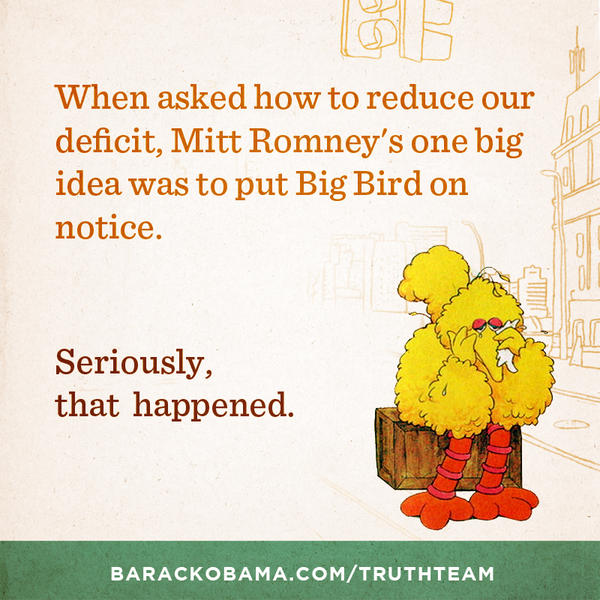
Now it's Big Bird's turn to be a Liberal meme.


Seriously, that's the best the Left has. Funny as it may be, it addresses no issue, and adds nothing to the discussion of this country's problems except snark and dismissiveness.

The day after Mitt Romney pointed out that Barack Obama's record with the economy is questionable, all the Left seemed capable of doing was spreading this meme around. Why is that? Maybe because when actually talking about issues, the Left has nothing but air and fluff. They couldn't really address any of the points Romney adroitly made in the debate. The Left can't stand on Obama's record. All they can do is make jokes that make other Liberals laugh.

One common thread - before the debate and after - for Liberals was that Mitt Romney hasn't been detailed with his proposals.

I think it's hilarious that the same people who screamed ambivalent slogans like "Hope" and "Change" and now "Forward" are demanding details. When did these people become so meticulous? All Obama has to do is say "Yes we can" and they cheer wildly. But with Romney, they demand details.

However specific or nonspecific Romney has been, he has a general plan to alter the course of the economy. All Obama has are jokes about Sesame Street characters. Well to borrow a word from my favorite Sesame Street resident, I think it's time for Obama to scram.


Thursday, October 04, 2012

Mitt Takes Gloves Off, Pummels Obama


We all thought Barack Obama was the skilled, smooth-talking debater, and Mitt Romney was the disconnected, awkward robot.

But in delivering their messages, Romney was a concise Power Point presentation. You could see bullet-points on the screen as he spoke. Obama was an unprepared professor without any notes, nursing a hangover, and ad-libbing his early morning lecture.

Even when not talking, Romney was winning. While listening to Obama, Romney maintained a polite but emotionless poker face. When Romney spoke, Obama hardly looked at him. He smirked smugly, and sometimes looked away, as if he didn't want to be there.

I think the endless series of GOP debates helped Romney prepare. The sweaty, white-hot crucible of Newt Gingrich & company seems to have turned Romney into a savvy debater. Obama has spent the last 4 years selling his policies and campaigning. He's accustomed to speaking in monologue, not dialogue. And the media doesn't ask him challenging questions. Last night was something new for Obama.

The substance of the debate also favored Romney. Obama reiterated some of his campaign's rhetoric about tax cuts for the rich, and about the deficit left by George W. Bush. Romney did well to address and dismiss those tactics.

Unfortunately for Obama, he couldn't boast much about his record. He tried boasting about Bill Clinton's then comparing it to his own. Meanwhile, Romney demonstrated an impressive understanding of economics and businesses. Every point Romney made ultimately led to job creation, how he plans to do it, and how Obama has failed to do it.

Last night the real Mitt Romney introduced himself to America, and to Barack Obama. For Obama's sake, he'd better have been paying more attention than it seemed like he was paying.

Tuesday, May 01, 2012

Forward: Obama's New Slogan

Barack Obama's campaign has come up with a new slogan. It's inspiring, abstract, vague, and includes the letter "O," which means that Obama's logo can be used as a letter.


But all it reminds me of is The Simpsons. Apologies for the low quality of the clip. It was the best I could find.


It's not a bad slogan. Ingenious, actually. It's powerful, but also allows people to envision their own idea of what "Forward" means. Then they think that Obama is for that particular idea. So people think Obama is fighting for their particular idea of what "Forward" is. It's an ambiguous message phrased directly. It's the type of brilliance that has been the cornerstone to Barack's success as a campaigner.

Of course, I doubt that having this "Forward" looking campaign will stop Obama from looking back on the Bush administration and blaming it for our debt. But I digress.

If Obama is re-elected, I'll be hoping to fast-Forward the next four years. HAHA...

I amuse myself so much.


Don't feel silly if you tried to click the above image. I did it too.

Tuesday, April 24, 2012

Obama University

Obama's background is college. He probably feels more at home at a university than anywhere else in the universe. Four years as an undergrad. Three more getting his JD. Twelve more teaching law at the University of Chicago. And this week he's going back to college campuses to campaign.

I could rant and rave about how he's using your tax money to do so. This trip to the Universities of North Carolina, Colorado, and Iowa is being called "official," and not political. Which means you're paying for it. It's a weird coincidence that all three of these states will be hotly contested in November. I could discourse about such expenditures being paid for by taxpayers being akin to Big Banks using Bailout money to fund "business trips" to Las Vegas. But that would be too easy. It would be an emotionally based tirade. And since Obama is barnstorming college campuses across the country, I'm going to try to keep things intellectual in this post.

Every week, the Obama Campaign Machine mobilizes on a new issue and attacks Mitt Romney and the Right. Remember that Phony War on Women a few weeks ago. How about Romney's car elevator. Last week it was the Buffett Rule. This week it's student loans. It's classic divide and conquer campaigning. Group people together, then point out how much you're on the side of their group, and how much your opponent is against that group.


Recent college grads are finding themselves in a very tough job market. 53.6% of recently graduated bachelor's degree holders are either unemployed or underemployed (Source). And these people are also burdened with massive amounts of student loan debt. The interest on which might increase from 3.4% to 6.8% in a few months.

A college education is less likely to result in a job. Yet the cost of that education has increased dramatically. How is it possible for the value of something to decrease at the same time that its price increases? Well that conversation is for another time. Part of the reason is that the price of college is artificially inflated by how easy it is to get a student loan. Which means it's easier for families to pay for college no matter what the actual price. Which means colleges can spend millions on new buildings and send out thousands of brochures that have pictures of students from 5 different ethnic groups on the cover.


Both Obama and Romney are in favor of legislation that would prevent student loan interest from doubling to 6.8%. And that makes sense. I think raising the rate would only raise the number of defaults. And politically, it's smart for both candidates to support college students that are struggling to pay off their debt. Students were part of Obama's base in 2008. And while Romney will never claim an outright victory in the 18-34 demographic, if he can convert a few of them, and avoid enraging the rest of them with higher interest rates, then he drastically improves his chances of victory in November.

Both Obama and Romney agree that recent college grads are facing enormous challenges. Where Obama and Romney differ is in the philosophy of how those problems should be fixed. Obama is focused on making it easier for them to survive in this harsh economic climate. He wants to give out umbrellas on a rainy day.

Romney, on the other hand, is focused on the climate. He wants a Government that taxes less and spends less. He wants policies that foster economic growth and to remove policies that hinder it, so jobs are created and recent college grads can afford to buy their own umbrellas.


So the question is, do people want a President who will take care of them when it rains. Or a President that will give them a chance to take care of themselves. Do you want to be taken care of, or take care of yourself? Do you want Dependence or Independence?

Wednesday, April 11, 2012

Rick Santorum Reads the Writing on the Wall, Drops Out... In Other News, Rick Santorum Can Read

As much insane fun as a brokered GOP Convention would have been, it won't happen. Rick Santorum has abruptly dropped out of the race to run against Barack Obama. And the Republican establishment has exhaled a collective sigh of relief, thus raising Greenhouse Gas levels across the continent.

Mitt is the only Republican candidate suitable for the task of removing Obama from office. Santorum was able to excite the passions of GOP voters, but he'd also scare off the moderates who will ultimately determine the winner of November's election.

CNN and other news outlets criticized Romney for being unable to "mobilize the base" of the Republican Party and win in GOP strongholds like Alabama and Georgia. But those electoral votes are now securely in his pocket simply because he is the Republican nominee and is not Barack Obama.

Santorum's bid was an expression of irrational passions. The media look down on such passions when expressed by Conservatives. Then glorify similar passion when expressed by Liberals. What is the difference between abstract slogans like "Hope" compared with "Freedom?" Look at how differently the media treated the Tea Party compared to Occupy Wall Street.

At any rate, Americans have had enough abstractness and slogans. They want concrete plans. And I'm not talking about bloated Stimulus funds to pour concrete on roads nobody travels on.

Americans want a President who will put them in a position to be successful. Not one who will coddle us when we fail, or when we don't even try.

We want results, not rhetoric.

We want a President that leads, not one that attacks those who disagree with him.

I am tired of the Campaigner in Chief. I am tired of his inexperience. I am tired of him inflaming when he should be discussing. I am tired of him turning serious issues that should be debated into opportunities to talk trash and make his opponents look bad.

Obama doesn't listen to the people. He tries to convert them, convince them, but never listens to them. He'll be forced to listen to us in November.

Mitt Romney can't save the economy on his own. He can't save the country on his own. But he can save us from Barack Obama.

Romney 2012.

Thursday, March 29, 2012

Breaking News: Mitt Romney Has Money

This was a huge story yesterday afternoon on CNN. Mitt Romney is putting a car elevator in the garage of his beach house. It's yet another example of Mitt Romney's almost cartoonish wealth. He might as well build a vault for all his gold coins and swim around in it Scrooge McDuck style.


While CNN's on-air personalities repeatedly stated that Romney need not "apologize" for his wealth, they repeatedly stated how things like this car elevator make Romney "out of touch" with regular, currently struggling, working class Americans. We don't have car lifts in our garages. Car lifts are for people who have so many cars, that their garage isn't big enough for all of them.


Romney is using the car elevator as part of the $12 million renovation of his beach house in La Jolla. The idea of the car elevator is to allow for multiple cars to be stored in a garage without expanding the ground level footprint of the garage.

I love how CNN, Politico, and most other media outlets feel that because Romney has more money than us "average folk" that he'll have trouble connecting with us. Especially in this harsh economic climate. People are struggling to fill their cars with gasoline and here's Rich Uncle Romney building elevators for his cars.

It's funny how JFK, despite being obscenely rich and coming from a rich old family, isn't seen as "disconnected" from the average masses of America.

FDR came from an extremely wealthy family (two wealthy families, actually), went to Groton, then Harvard, and yet somehow was able to take office in a harsh economic climate and connect with the "average people."

And how connected is Barack Obama to the 99%? His net worth is estimated between $2.8 and $11.8 million dollars.

Is there a feeling of disconnection between the average American and Mitt Romney? Yes! But there's also a feeling of disconnection between many average Americans and Barack Obama. And it has nothing to do with wealth, or background, or race.

It's about ideas. It's about dreams.

Mitt Romney doesn't just have money, he has a shitload of money.


And I want that. Millions of average Americans will be buying MegaMillions tickets this week so we can feel connected to the likes of Mitt Romney. I want an elevator for all my cars. I want to be comfortable. I want to take care of my friends and family. I want to travel. I want money.


I don't want a President to understand me, to feel connected with me. When was the last President that was truly connected with the American people? They're all borderline schizophrenics.

And these Liberal intellectuals on Politico and Huffington Post are so insulting with their "average folk" rhetoric. All the so-called "average" people in this country are different, we're all separate individuals. We all have different dreams, different desires, different ideas. I'm offended at being called "average." I'm offended by the notion that these media folk think that millions of Americans are so simple and function with a simplistic herd mentality.

It's true, Mitt Romney would not understand what your feet feel like and what your brain feels like after working a 12 hour security shift for $9/hour. Neither would Barack Obama. And I don't care.

I don't want a President to sympathize with me and coddle me and make me feel like I'm being understood and acknowledged. I want someone who can Run this country, who can help put me in the best position to help myself, who can give me the opportunity to achieve what I feel like I'm capable of achieving.

I don't care about car elevators, I want a President who can elevate America. And despite his absurd wealth, his stilted awkwardness, and his constant cheerfulness, I feel like that person is Mitt Romney.

Friday, March 16, 2012

The Chevy Volt vs. Common Sense

"It was nice. I’ll bet it drives real good. And five years from now when I’m not president anymore, I’ll buy one and drive it myself."
-Barack Obama, on the Chevrolet Volt

The President made this declaration just a few days before GM halted production of the Volt. It's simply not selling as well as anticipated. Dealers' inventories are backing up as production outstrips demand for Chevy's "plug-in hybrid electric vehicle" (PHEV).

Despite the $7,500 tax credit given to Volt buyers (Obama has proposed increasing that to $10,000), only 9,623 of the cars have been sold in North America through February 2012. 3,600 Volts are sitting around dealership lots, waiting like unwanted puppies to be adopted and taken to a good home. GM had once planned to produce 45,000 Volts in 2012. That is no longer their goal. (Source)

Why would you buy a Volt? To save money on gas? Even with the $7,500 tax credit it would take the average driver 9 to 12 years to save enough money on gas to recover the price difference between the Volt and the equivalent Chevy Cruze. 9 years with gas at $5/gallon, 12 years with gas at $4/gallon. (Source) And by then, the battery will have lost 20 to 30 percent of its range. (Source) A new battery costs $14,000. So by the time the Volt "pays for itself," it needs a new battery. And after three years, Kelly Blue Book predicts that used Volts will be worth about $17,000. (Source)

You'll need to buy a $14,000 battery to propel your car worth $17,000.

So you don't save money. Depending on where your house gets electricity from, you might not do much to help the environment (coal=electricity+pollution). And while you'll use less oil from the Middle East, you'll be buying a battery made from Chinese lithium and rare earth elements. You're trading dependency on one foreign market for dependency on another.

The only reason to buy a Volt is so you can call yourself a Volt driver. Which is fine. Plenty of people do that with Corvettes, Ferraris, Porches, BMWs, and so on. They like to make a statement with the vehicle they drive. Cars aren't just functional, they have style and personality. They're like clothes. So if people want to "wear" a Volt as a statement about themselves, good for them. All cars should make a statement. That's why we get to choose what color we want our cars to be.

Unfortunately, the actual people who NEED to save money at the pumps cannot afford a Volt. Not in the short-term with its high upfront cost, not in the long run with its depreciation and need to replace the battery. Right now the tax-credits are only helping the rich people who buy Volts as part of their automotive wardrobe.

And isn't the President against giving tax breaks to the wealthy?

Obama wanted 1 million PHEVs like the Volt on the roads of America by 2015. But common sense is against the Volt. It's a statement-vehicle for wealthy environmentalists, not a fuel-efficient people's car. And if you have to pay people $10,000 to buy a car, doesn't that speak volumes about the lack of demand for it?

PHEV technology is the future. It's not the present. That's why nobody is buying it, nor should they. The technology simply isn't good enough yet for Volts to be a successful consumer good.

The Volt is also an example as to why Government shouldn't guide an Economy. It's one thing to fund research into better battery technology with taxpayer money. It's another thing to hand $7,500 to someone because they want a Volt, or to give UAW-GM workers a job just because they make a Volt.

Instead of investing taxpayer money into encouraging people to buy a product they don't want, the Government should use that money to help the product develop into something that people would want. Spend some money to research military applications of electrically propelled vehicles (they'd be quieter, and you wouldn't need to constantly resupply them with oil-based fuels).

Consumers control markets. Not products. Not Governments. The idea of Government controlling the economy disturbs me. Government struggles to run itself, let alone the automotive industry. But Obama and his ilk think that they know better than the free market.

But they don't. Just look at the money-saving, environmentally friendly car they want us to buy. It's called the Volt and it doesn't save you money or help the environment.

Thursday, September 08, 2011

GOP Debate

Just some quick thoughts after the GOP Debate last night. This is the point of the campaign that some horses will pull away from the pack, and others will fall out of the race. And after last night, it's become clear to me who the top two candidates for the Republican nomination will be.

Michele Bachmann brought nothing but the word "Obama" and hatred for his policies. And that's fine, but people want solutions not just blame. Besides, she's wrong. I'm anti-Obamacare, but it's ludicrous to blame it for the economic crisis we're in since said crisis began well before Obama was elected.


Bachmann is a polarizing figure that had rallied extreme conservatives, and became a nice joke for the Left. For a few weeks, she was Jon Stewart's 2nd favorite person in the world (behind himself, of course) She's a clown though. She makes Katherine Harris seem well-balanced, and Sarah Palin seem well-read.

Ron Paul is a psycho. How can you want the private sector to run the FDA or FAA? How can you be against the existence of FEMA and blame the victims of natural disasters by saying that they "build where they shouldn't be building." Tell that to the people of Vermont who are currently dealing with hurricane induced flooding. What morons those Vermonters. Don't they know that it's Hurricane Alley up there?


Newt Gingrich is nothing more than an embedded Fox News pundit, covering the campaign from within. Even the questions he was asked were about the campaign itself, and not about what Newt would do if he were President.

Rick Santorum was personable, but not exciting. He's honest and nice. As Chris Matthews said, Santorum doesn't "play games." And we all know that the nice guy who doesn't play games is the guy that goes home alone on Saturday night.

Jon Huntsman tried to be worldly, and I'll give him credit for being the most aggressive candidate that also retained dignity. He tried to emphasize his relatively small amount of economic experience. Unfortunately, this is just the wrong campaign at the wrong time for Huntsman.

Herman Cain was my personal favorite. He was like Steve Forbes, only instead of being creepy, he was charismatic, incisive, and concise. You could tell that he's been the CEO of a large company. He was like a PowerPoint presentation. He had clear plans to fix problems, and wasn't just spitting rhetoric. Unfortunately, he's not a politician. He can conceive great, sweeping ideas like his 9-9-9 plan, but I don't think he'd have the political savvy to get them passed and implemented, let alone get elected in the first place.

The Presidency is not like being a CEO. CEOs need direction, drive, and decisiveness. President's need to be able to compromise and convince. I don't think Cain will make it that far. But I kind of wish he would.


Then there's the top two: Romney and Perry. One of these guys will be running for President in 2012. The other will be running for Vice President. Texas and Massachusetts together again, like in 1960.


Rick Perry was the target of the debate. He was the only one who seemed to be getting criticized by the moderators more than by his fellow candidates. He was attacked on health insurance coverage in Texas, education, his book, minimum wage jobs, HPV vaccinations, Social Security. It was relentless.

Perry is correct. Social Security is a Ponzi scheme. But it's stupid to say so in a political campaign. That being said, Perry has the strongest personality among these candidates. If George W. Bush was the candidate that John Q. Voter wanted to have a beer with, Rick Perry is the candidate I'd want to have with me if we were trapped in the desert, or the Arctic. I'd also like to go drinking with him.

Mitt Romney is more electable in a general election. Rick Perry is more likely to energize and appeal to Conservatives. I think it's clear that the Right is excited about Rick Perry. Their hearts may be behind Rick, but their brains are with Mitt. At least they should be.

One thing I find ironic is that this party has 8+ candidates, and doesn't seem to have a single, clear leader, yet the GOP seem much more unified than the Democrats. The Democrats don't have that single-voice, they don't all stand together and yell at the moderator of a debate. Hell, Obama doesn't even speak with a single-voice.

These Republicans are all for reduced spending, reduced taxation, an end to Obamacare, the securing of our border. This debate was not a rabble of screaming voices. How often did one candidate interrupt another? How much more often did they interrupt the moderators? How many times did individual candidates point out how unified they all were as a group?


The Left will focus on Rick Perry being "anti-science," on him calling Social Security a Ponzi scheme, and nobody in the political Center of the country will care about either issue next November. It's about jobs. It's about the economy. People without jobs want jobs. People with jobs want better jobs. People with good jobs want their kids to get jobs so they move out of their house.

Yet watching MSNBC's post-debate analysis, they focused on how Rick Perry described Social Security. Even going so far as to call it the "key moment" of the debate. Probably because it's their best opportunity to criticize Perry. Then they went on to criticize Ronald Reagan's tax policies, because that's somehow relevant?

In the end, though, America will elect the candidate who they feel will do the best job at getting them jobs. Romney seems to have the brains, Perry seems to engender the confidence. If they could harness and balance those abilities as a team, they'll be a strong challenge to Obama in 2012.

Thursday, August 11, 2011

Obama's Afghanistan

On the 6th of August, 30 Americans fighting in Afghanistan died when their Chinook helicopter was shot down by Taliban insurgents. 17 of them were Navy SEALs. 5 were Navy specialists attached to the SEALs. 3 were Air Force forward air controllers. 5 were the Army crew that flew the helicopter. 8 Afghans (7 soldiers and 1 civilian interpreter) were also killed.

Why? For what purpose? These men trained for years to be the best at what they do. Why were their talents being utilized in eastern Afghanistan? All their hard work, all the expertise of the helicopter crew and the Air Force controllers, all the dedication of the SEALs. It was all blown apart by a rocket propelled grenade. And for what?

These men had meaning, they had purpose. But their lives were lost in an endeavor that no longer has meaning, that has an impossible purpose, and which will soon be abandoned in a gradual withdrawal process. It's been 10 years of toil and death in Afghanistan. We destroyed the Taliban, tried propping up a corrupt government in its place, and allowed the Taliban to be born again.

Who's winning this war? We're certainly not winning. It's hard to say if the Taliban is or isn't. Frankly, it's turned into an Afghan civil war, and it needs to be fought and won/lost by Afghans.

Who's losing? The people doing the dying. The SEALs, the Marines, the Soldiers, the Airmen, they are the ones losing. Obama said that the Chinook crash is a reminder of the "extraordinary sacrifices" of our servicemen. Sacrifices to what end?

It's time to leave Afghanistan. Right fucking now. No gradual withdrawing one unit at a time. Everyone out.

It's hard to blame Obama for a 10 year war, especially since he's only been President for a little over 2 of those years. I can't blame him for strategic failures by Generals, for subpar equipment from the Pentagon's "procurement" people. I can't blame him for some insurgent's lucky shot with an RPG. But I can blame him for our continued presence in this war. I can blame him for being too politically savvy. I can blame him for trying to please and appease everyone at all times.

Obama's policies and philosophy in Afghanistan is a perfect example as to how he's conducted himself as President. He's been bending over backwards to compromise with the very vocal Conservatives, who have in turn been bending him over the barrel. He wants to be everyone's President, not just the Left's. That's commendable, in theory. It's disastrous in practice. And this desire to be loved by all, hated by none, has led to even his base to start criticizing him.

Last summer, Obama announced a surge of troops in Afghanistan. But he also effectively declared an unofficial deadline for operations there to be successful. If not, US troops would be pulled out. It apparently appeased everyone. The Cable News Generals on the Right, and the neo-hippie Lennonite pacifists on the Left. We'd have war for a year, then peace. Even I applauded Obama's shrewdness for putting himself in a seemingly no-lose situation.

But that's been the theme of his Presidency. Compromise, and trying to avoid losing. And it hasn't worked. It hasn't worked in Afghanistan, where Americans are dying because their timetables for withdrawal haven't been finalized on Microsoft Excel. It hasn't worked with the Stimulus Plan, which was compromised down in size thus preventing it from being effective (I don't think it would have been that effective anyway, but it never had a chance once it was reduced). It hasn't worked on taxing the rich and easing taxes on the middle-class. It hasn't worked to create jobs, or reform healthcare, or save the environment, et cetera.

Say what you will about George W. Bush, but when he believed in something, he tried to get it done until he was physically stopped. He stuck to his principles. He bullied Congress to get what he wanted. And now, the Right is bullying Obama for what they want. Even with control of the Senate, Obama is too unwilling to make enemies. A Democratic President, a Democratic Senate, and the Republicans are dictating terms. You can't make compromises with uncompromising people. See: Munich, 1938.

I don't know what Obama's core principles were or are concerning Afghanistan. I know he's compromised his own principles so many times in so many political dogfights that it's hard to call them principles anymore. Principles are strong, and only abandoned as an extreme measure. Obama has platforms and beliefs, not principles.

He's very skilled at not revealing how he truly feels about certain issues. I still have no idea if he smokes cigarettes or not. He's very smooth, very political, and that might be simultaneously his greatest strength and most unfortunate weakness.

Whatever Obama's principles are in Afghanistan, it's time to leave. The argument that a speedy exit would leave that country in chaos suggests that it isn't already a tattered mess over there. The argument that it wouldn't be a dignified exit for our troops makes the absurd suggestion that politicians can do anything to take away dignity from the men and women of our military. Politicians can't steal a Soldier's dignity, only their life.

It is time for that theft of life to stop.

Photo: Reuters

Tuesday, May 03, 2011

Been Laden

"We got him." We. That 3rd person plural pronoun that encapsulates 300 million people with two letters. We're typically a we only when something tragic occurs.

In this War on Terror, there are no enemy Divisions to annihilate, no capital cities to take. There's no ground to gain, no head of state to surrender, or kill themselves in a bunker. There are no sunken battleships, no captured tanks, no trophies. Only casualties and confusion.

Until May 1st, 2011.

The War on Terror is not over. Just ask the various agencies now on high alert for a terrorist response. This War will never truly end in the way past wars have ended. There are plenty of terrorist sheep and shepherds from Libya to Saudi Arabia to Pakistan to Chechnya. They all hate us even more now. We've killed one of their idols. They'll try to destroy us even without Bin Laden.

But Bin Laden was important, in sort of a self-fulfilling prophesy kind of way. He was important because we felt he was important. And because his followers felt he was important. He was the charismatic leader of legions of would-be murderers. He was a spokesman, a PR guy, a recruitment tool. He was a standard to rally around. The anti-Uncle Sam, personified. And maybe our enemies won't have as much focus and direction now that he's been erased.

The closest thing I'd compare Bin Laden to, ironically, is an 11th century Crusader. He was one of the Saudi Arabian aristocracy that applied his material wealth to a fanatic cause instead of simply living a life of lavish extravagance. He wanted to wipe out all threats to his beliefs and wanted to forcibly change the world. He was very much like a Norman nobleman, spending his vast fortune on a quest to "save" the Holy Land through violence. He has more in common with the Crusading infidels than with the likes of anti-Crusade Islamic leaders such as Saladin.


And now he's dead. And it was the much maligned US intelligence community that incited his death. The same intelligence apparatus that failed to warn us of 9/11, that failed to find Bin Laden for 10 years, and that was duped into believing Iraq had WMDs.

It was human intelligence, partially gathered from Guantanimo Bay, which Obama had once wanted to shut down. It was a military operation executed to perfection. No US casualties. No civilian casualties. One body recovered, in near mint condition.


A cruise missile or drone strike might have yielded the same ultimate result, but without the tactile, visible proof of a corpse.

It was a ballsy attack. Obama certainly deserves a great deal of credit for having the stones to give the order. Everyone from he to the CIA to the planners of the operation to the guys who carried it out to the people who knew about it and kept their mouths shut. They all deserve credit.

The circumstances around Osama's hiding spot are beyond sketchy. While top levels of Pakistan's government profess to be "with us" in this War on Terror, it's difficult to fully believe that. Bin Laden moves into a neighborhood of Pakistani Generals, in the biggest house for miles, and nobody knows he's there? Come on.


I don't know everyone who lives in my neighborhood, and generally we all keep to ourselves, but I do know that Ernie Boch Jr. lives in the biggest house in the area. Everyone knows that. Just like before he lived there, a weird commune/cult of 20 people occupied the house, and before that there was a rich old lady. Everyone knows when someone moves into the biggest house on the block.

"If you're not with us, you're against us."

GW Bush got criticized for that polarizing statement. But it has a breath of truth to it. We can see by the various reactions around the world, who is with us, and who is against us. It's difficult to classify Pakistan as being "with us." Then again, they've registered no official complaint about violating sovereign territory of theirs. So who knows. I think they're split as to which side to be on.

But they're in the wrong geographic spot at the wrong moment in history to be split.

There's a long, long way to go. The War on Terror won't be won with Divisional level ground operations like those in Iraq or Afghanistan. Those can topple governments that support Terror, but installing new ones is next to impossible, and a needless waste of life and material.

Even house-to-house operations, road blocks, checkpoints, and border patrols are too cumbersome, too ineffective, and too easily circumvented.

More operations like this one are needed. War Party Tactics, I call them. Like the Pequots of 1635, or the Wampanoags of 1675, or the Apaches of the 1800s. Small, ultra-mobile bands of elite warriors, on short-term missions against small but highly valuable targets. Imagine if Geronimo had helicopters, machine guns, grenades, and an effective intelligence apparatus.


Think about it. After 10 years in Afghanistan, after nearly 1,500 US deaths, 2,400 coalition deaths, over 7,500 Afghan Security Force deaths, and tens of thousands of civilian deaths; it was a 40 minute, 0 casualty, 0 collateral damage operation that was the biggest victory of this War since the Taliban was ousted.

The lesson here is that human intelligence is integral. The US intelligence community can't just sift through millions of e-mails and phone calls, hoping to harvest a crop of valuable facts. There needs to be real, actionable information. Texture to add depth and dimension to the data.

And the US military needs to focus its monstrous power on supporting smaller but intensely focused, laser-like operations. No need for Shock and Awe. No need for entire Divisions of infantry to be deployed against villages and huts.

As we incorporate the sharp, bittersweet joy of Osama's death into our lives, and it seems to fade away, we'll start to politicize these events. Already, pundits are looking ahead to the 2012 Presidential campaign, giving Obama a huge edge because of this. And they're right. Although, the biggest GOP threats to him were Sarah Palin and Donald Trump, which might be threatening if Obama were trying to launch a reality TV show, as opposed to winning an election.

There are already judgmental uberpacifists whining about their fellow citizens celebrating the death of a mass murderer. And while I understand why many feel uncomfortable about enjoying death, it's my right to enjoy his demise. After all, we didn't kill Osama because he was Muslim. We didn't kill him because he hated us. We killed him because he killed our fellow citizens. He made us live with fear. He would have killed more of us if he had the chance.

People like Kai Wright are moaning that The Ability to Kill Bin Laden Does Not Make America Great. I'm seeing Martin Luther King Jr. quotes everywhere. "Returning hate for hate multiplies hate, adding deeper darkness to a night already devoid of stars." Edmund Burke perfectly expressed my responding thought to that:

"All that is necessary for the triumph of evil is that good men do nothing."

While even the most ardent of the uberpacifists agrees that Bin Laden should be dead, they still don't understand why the rest of us are celebrating death. I for one am not celebrating out of hatred. I'm celebrating the triumph of good over evil. I think that such a triumph is worth a few frathouse antics in front of the White House, a toast of beer to our troops, I'm even praising Barack Obama.

Evil did not triumph on May 1st, 2011. And I'm happy.

I'm only 26 years old. 9/11 was one of the defining moments of my youth. I was sitting in high school physics class when it happened. I had a free period after and went to a study center to listen to the news on the radio. Hearing descriptions like "the tower just collapsed," and being unable to conjure such a surreal image in my brain.


The whole country changed that day. There was a sense of vulnerability we all realized. We're still vulnerable. But we're also a bit prouder today. It was painful to think that somebody could assault us with impunity. So while the War wages on, while we still take off our shoes at the airport, at least that pain of seeing Osama get away with murder can now dissipate.

May 1st was a great day for Americans, and a great day for America.

Wednesday, January 26, 2011

State of the Obama


It's funny how much hype leads up to the State of the Union, then how much discussion shortly follows, then how little we'll remember it in a month. It's not known for rousing oratory, or startling surprises. It's so routine that there's a countless variety of drinking games one can play while watching.


We need to revive the economy. "We do big things." That's a good summary of the speech. We do big things and put them down. We do big things and put them down.


Obama started with the need to improve education. Which I completely agree with. At all levels, our country's education is not competitive. And any quality education costs money, whether it's a private middle school, or a top-flight grad school. So in other words, it's not necessarily the best and brightest students who enjoy the benefits of the best education, its the most affluent ones.

Then Obama loses me, when he starts talking about China building solar energy facilities, and how we need to catch up. Is that why China's economy is growing, and ours isn't? Because of solar technology? I don't think so.

While I love the idea of rebuilding our educational system, emphasizing math and science (and basic writing, just read the comments on any YouTube video), and investing in new technologies, why does it always have to be "clean energy?" Is that the ultimate goal of technology? The pinnacle of mankind's achievements? Solar panels?

I think renewable and sustainable energy is a nice idea, but why don't we invest in education and technology, then let the next generation of smart people tell us what the new big thing is going to be. I can't imagine that in a history book 50 years from now, there'll be a sentence that reads "America's economy was saved by wind turbines."


And here's a hint, Liberals: If you want to sell the country on "clean energy," call it something else. CHEAP ENERGY. That gets the consumer excited. It's amazing how environmentally conscientious people will become when it affects the green in their wallets.

Getting back to education, Obama made some excellent points about how non-affordable it is. And Government can help that. I'd rather the Government give out grants (not loans) so students can go to the school of their choice (not just go to a college, but go to the college they choose), regardless of their economic status. There's responsibility and accountability in a program like that. If grades aren't up to snuff, then goodbye. I'd rather give Government money out in that fashion than via standardized entitlement checks.

But there's also a social and cultural problem undermining the quality of our education. College is for partying and passing. "C's get degrees." The people who have the opportunity to go to school take it for granted. Because there are no apparent consequences for failure. They've been brought up in a spoon-fed, coddled, everything-will-be-alright society. And this attitude needs to change. There's not much Government or Politicians can do about it. It's something that individuals need to do on their own. And I think a lot of people my age (mid-20's) are realizing that life is harder than school.

Most of this speech was recycled from previous remarks. Obama thinks that it's 1933 and that the country can be saved by The New Deal. He calls it "investing in infrastructure." But it can also be called "spending on roads."


While our highways and bridges are in dire need of repair, they should be fixed because they're broken, not because the economy is broken. All these projects don't do much to add jobs, and do little to help the economy. They help construction workers, and the contractors that employ them. That's about it.

Obama promised to "pick projects based on what's best for the economy, not politicians." Which is a very smooth, slick thing to say. What does "best for the economy" mean, though? Those construction workers expanding Route 128 might have one idea of what's best for the economy, and I might have another.

Politicians, even if acting under completely noble ideals, cannot "pick" what's best for an economy. The economy has to pick what's best for itself. It's called the free market. The idea of Politicians selecting who gets what, even with the best of intentions, curdles my blood.

Obama is against the tax-cuts given to the wealthiest 2% of Americans. Well, I'd rather that they pay taxes as opposed to me. But ultimately, I'd rather that neither of us have to pay much at all. Because when that wealthy person has more pocket money, they might invest in promoting a concert at Gillette Stadium, and I might get 10 hours of security work because of that. Or at the very least, they might buy a ticket to an existing concert, and part of that money eventually finds its way to me.

One thing's for sure, I trust that rich person to do something economically beneficial with that money more than I'd trust the Government.

Then there's healthcare. What Obama said about that, ironically, made me sick. "Let's fix what needs fixing and let's move forward." That's unimaginably arrogant and dismissive. There's a reason why Nancy Pelosi isn't sitting behind his left shoulder anymore. Many in this country rallied against Obama's healthcare reform. But I guess we should just move on. What's done is done. After all, it's not as if our Constitution allows for the repeal of undesirable laws.


Obama has seemed to respond to the voices calling for a reduction in government spending. But he and the Liberals will resist every cut. And Politicians from both sides will protect pet projects from their home states. They'll lobby for reduced military spending, except when it affects the Air Force base within their borders.

"I'm willing to eliminate whatever we can honestly afford to do without."

That phrase is an exquisite example of beautifully crafted rhetoric. Persuasion by Agreement. Obama has millions of voices screaming at him to cut the budget. So he agrees with them. But adds the caveat of "whatever we can honestly afford to do without." He wisely omits that it will be he and his Administration that decides what "we" can afford to cut.

It should be against the law for politicians to use the word "honestly."

And I loved his analogy to lightening an airplane by removing one of its engines. Well if the thing is too heavy to sustain flight, what's the point of having 4 engines or 0 engines? Maybe it needs a complete overhaul. Maybe it needs more things removed than "we can honestly afford to do without." Maybe we need a new plane.

We certainly need a new pilot.

Tuesday, July 27, 2010

When Will the Recession Recede?

I'll concede that Barack was given a full plate when he was elected. A Marlon Brando portion of things to digest. We were deep into two wars, with a crashing economy, and that's just the tip of the iceberg. Since his election, he's had to deal with things like one of the worst man-made disasters ever, the immigration issue, healthcare reform (although he started that fight), and the "stupidity" of the Cambridge Police.

That all being said, he made the big promises. He was Change personified. He was Hope incarnate. He'd fix the economy, extract us from wars while keeping our dignity, he'd reform healthcare, he'd save us from the apparent tailspin we've been sent on by George W. Bush.


Maybe it's just me and my gloomy pessimism. But not even Barack could bring our economy back to where it was, or where it's been since World War II. He can, however, make it worse. And that's what he's doing. Inadvertently, of course.

We've had a bubbilicious economy lately. Big ups, big downs, but with a generally upward trend. Like Oprah's weight. But it's all been part of a massive superbubble. The World War II Bubble. The War fueled unprecedented growth and prosperity for America. We built all the planes and tanks. We provided the gasoline. We sold the ships. We lent the money. The US produced 40% of the world's weapons during the War.


Then after the War, we didn't have to rebuild. We sold industrial machinery to Europe and Japan for them to restore their infrastructure. We also sold them the finished products. And again, we lent them the money.

But the world's caught up. And industrially speaking, the US has fallen behind. So now instead of steady growth with the occasional hiccup, our growth is rapid, followed by quick contractions, then fast growth, then fast retractions. Our economy has stretch marks and loose skin. We've morphed from the stable tortoise to the impetuous hare.


We want to get back to where we were. And the Liberals think they know how to do this: Socialism Lite.


The latest push has been to extend unemployment benefits. A lot of people who lost their jobs in the latest economic fracas are seeing their benefits expire. Those benefits had been extended once before. Back then, it was thought by Barack and his cadre of optimists that the unemployment rate would peak at slightly over 8%, then gradually reduce itself. Instead, it's been fairly steady, and over 9%.


This chart is an estimate from late '09.

Barack will publicly pat himself on the back for how many jobs he and his programs have saved. But I don't remember his "Institutional 9.5% Unemployment" speech on the campaign trail. He promised more.

The idea of unemployment benefits is not only to keep people alive, it's to stabilize the system, to keep the bad times from getting really horrid. It keeps people involved as participants in the economy: buying food and clothes, renting apartments, etc. So when things get better and jobs become available, they can rejoin the workforce without missing a beat.

Most of the time, unemployment is paid for by taxing employers, so it functions as insurance. The employees and employers regularly pay a small, manageable amount, and therefore protect themselves in case of disaster.

The only thing I don't like about unemployment benefits is that it's based on income. So a middle manager who made $100k a year will receive a bigger check than the janitor who made $20k when their company goes under. This capitalist-socialist mutant is an abomination, a sin against nature. Unemployment is to subsist people between jobs, and it costs the same for a janitor to feed himself as it does for a middle manager.

And in this current climate, the government is essentially subsidizing some people to NOT get jobs. It's that ex-middle manager with that $100k salary and the bigger unemployment check that will hold out for another $100k job, instead of taking one with a $40k salary. It's basic common sense that those $100k jobs are an endangered species in this contracting economy. So it follows that those $100k types will have to find jobs that pay less. If Mr. Executive were receiving the same meager unemployment benefits as Mr. Janitor, you can bet your ass he'd take a $40k job pushing paper.


But there's a problem. When does a temporary benefit to tide people over between jobs turn into a permanent government dole? And where does the money for extended benefits come from?

Having 9% of the country getting weekly government checks for doing nothing for an extended period of time is a destructive concept. Doesn't the government spend enough money paying its own employees to do nothing? The money has to come from somewhere. And it's coming from debt. "Treasury Bills" is the politically expedient way to phrase it, but "selling" treasury bills is a misleading way of saying "borrowing money."

I have no problem with extending benefits right here and right now. But this has got to be it. And there needs to be reform that forces middle and upper class people to take lower paying jobs when they can. To issue a $500 weekly check to someone who's been offered $900/week to work is utterly disgusting. They can take a step down and work while they try to find another lucrative job.

But we need to adjust here. We are not going to go back to the way things were. Not permanently, at least. Barack and the Liberals can distribute temporary relief. They can borrow from China and give everyone free healthcare. But that bubble will only burst with more explosiveness.

As we add more and more social programs, issue more and more benefits, we're jumping off a burning ship into shark infested waters. We're trading one problem for another. Instead, we should be trying to put the fire out, and limp along in our burnt out vessel. Our economy will never be the same. And the more Barack tries to bring us back to where we were, the more he hastens the ultimate destruction of the American economy.

Then again, I'm morbidly pessimistic. But just because you're paranoid doesn't mean they're not out to get you.


Monday, April 26, 2010

Baracktionary


Jean-Jacques Rousseau once wrote in a letter: "Learn my dictionary, my good friend, if you want to have us understand each other. Believe me, my terms rarely have the ordinary sense."

Throughout history, great thinkers and leaders almost invariably develop their own idiomatic and peculiar ways of conversing. Essentially, they develop their own languages. Words acquire new definitions when these historical giants use them. "Worker" takes on a new meaning when uttered by Karl Marx. "Peace" meant something different to Woodrow Wilson than it did to Kaiser Wilhelm. Thomas Paine's usage of the word "liberty" is stronger than almost anyone else's.

Barack too, has his own definitions for the words he chooses to use. And here I'll humbly attempt to catalog some of them. Although admittedly, I am insufficiently intelligent to truly understand the Barackish language. And so I apologize for my omissions and potential errors. Without further preamble, the meaning of certain terms, according to Barack:

Bipartisanship (noun): when Republicans agree with my policies, and I get to do whatever I want to do

Partisan politics (noun): when Republicans disagree with my policies, and I don't get to do whatever I want to do. I have to debate things :-(

Unity (noun): when everyone in Washington follows my lead

Vitriolic (adj): the manner by which anyone who disagrees with me expresses that disagreement

Look... (verb, used at the beginning of sentences as a command): a warning that I'm about to tell you something you were too stupid to previously know. Example: "Look. You know, what we've done has been successful throughout. I mean, it's not like I've been winning in states that only have either black voters or Chablis-drinking, you know, limousine liberals. I mean, we've been winning in places like Idaho. We've been winning in places like Colorado."

China (noun): an ATM


Town Hall (noun):
1. Before healthcare reform rabble: a forum for the Democrats and I to listen to concerned citizens voice their opinions about healthcare reform.
2. After healthcare reform rabble: an opportunity to paint all conservatives as ignorant and/or racist.

Racist (noun): a Tea Party member


Reform (noun): Always a good thing so long as it's my kind of reform

George W. Bush (noun): The cause of all your problems, and all the debt we're in

This one's my favorite...

Debt (noun): A way to get out of debt

Iraq (noun): A remote corner of the world where we once sent soldiers to fight for obscure, abstract, and wholly unattainable goals. But that was wrong.

Afghanistan (noun): A remote corner of the world where we still send soldiers to fight for obscure, abstract, and wholly unattainable goals. But this is right.

Surge (verb/noun): To increase the amount of US soldiers in a foreign country's war, a good way to seem tough on America's enemies while also winning the Nobel Peace Prize because "surge" sounds better than "escalation"

US soldier's casket (noun): Photo op


Gay rights (noun): The right to file joint tax returns, or visit a partner in a hospital (mention that a lot), but NOT to get married (avoid mentioning that)

Smoking (noun): an activity I may or may not still do

Public support (noun): A nice thing to have, but not necessary when signing massive legislation like healthcare reform

Wall Street (noun): where evil and greed originate, where greedy bankers want to get paid tons of money for their easy, white-collar work


Main Street (noun): where wholesomeness and kindness originate, where non-greedy people want something for nothing, and they deserve it!

Journalist (noun): Someone who works in the media and also agrees with me


Non-journalist (noun): Fox News, or anyone else that dare questions my glory

Franklin D. Roosevelt (noun): God

Hope (noun): something I give everyday to the American people, whether they want it or not

Sanctions (noun): a strategy that almost always works to curb the threat posed by maniacal despotic states

Nuclear Security Summit (noun): what will win me Nobel Prize #2 because we talked a great deal about talking

Economy (noun): something the Government should control

Your life (noun): something people should control, unless they disagree with me, which more and more people seem to be doing. But in the event of disagreement, the Government should control this.